EN
Fibre Making Machine Applications in Nonwoven Industry
A fibre making machine can mean different equipment to different project teams. In nonwoven production, it may refer to a line that makes staple fibre for a later web-forming process, or to equipment that turns polymer into filaments as part of a direct-spun route. That distinction matters before a specification, layout, or budget discussion begins. The useful question is not simply which fibre making machine to buy; it is what fibre form, web structure, bonding route, and finished-use requirement the line must support.
For engineering, production, procurement, and quality teams, a fibre making machine decision is therefore a system decision. Feedstock condition, fibre characteristics, opening or spinning, web formation, bonding, handling, controls, utilities, and test methods all affect whether a proposed configuration suits the intended application. This article maps those relationships for teams planning nonwoven production.
Start with the nonwoven application, not the machine name
Nonwovens are engineered fibrous assemblies whose integrity is achieved by physical and/or chemical means. That broad vocabulary, reflected in ISO 9092 terminology, covers very different textile applications. A filtration layer, hygiene component, cushioning layer, automotive interior material, cleaning substrate, or geotextile can require a different balance of strength, softness, bulk, absorption, filtration behavior, appearance, or process stability.
Before selecting a fibre making machine, turn the end use into a short requirement sheet. Include the intended fiber materials, whether the web begins with staple fibre or directly spun filaments, the expected bonding route, target basis-weight range, product width, operating environment, and the test evidence needed for acceptance. Avoid treating a target characteristic as a machine promise. It should be a project hypothesis to be evaluated with the selected material, process conditions, and validation plan.
Where a fibre making machine fits in nonwoven production
There are two practical pathways to separate during early discussions. In a staple-fibre pathway, a fibre making machine produces or prepares fibre that later enters opening, blending, carding, airlaying, and bonding operations. In a direct-spun pathway, polymer is extruded into continuous filaments that are attenuated, laid into a web, and bonded within an integrated process. The terms are sometimes used loosely, but the interfaces, material questions, and controls are not the same.
Staple fibre for drylaid and airlaid routes
For drylaid-carded nonwoven production, fibres are commonly opened and blended before air transport to a card, where they are combed into a web. This sequence makes fibre consistency and opening behavior relevant to downstream web uniformity. A fibre making machine intended to supply staple fibre should therefore be assessed alongside bale or tow handling, blending needs, card feed, waste handling, and the bonding method rather than as an isolated asset.
Airlaid routes place different emphasis on fibre dispersion and web formation. Here, the fibre length, stiffness, moisture condition, blend behavior, and potential addition of other components can affect how the material moves through the forming zone. A project team should identify the permitted fiber materials and mix boundaries before it assumes that one fibre making machine configuration suits every airlaid product.
Direct-spun webs: spunlaid and meltblown
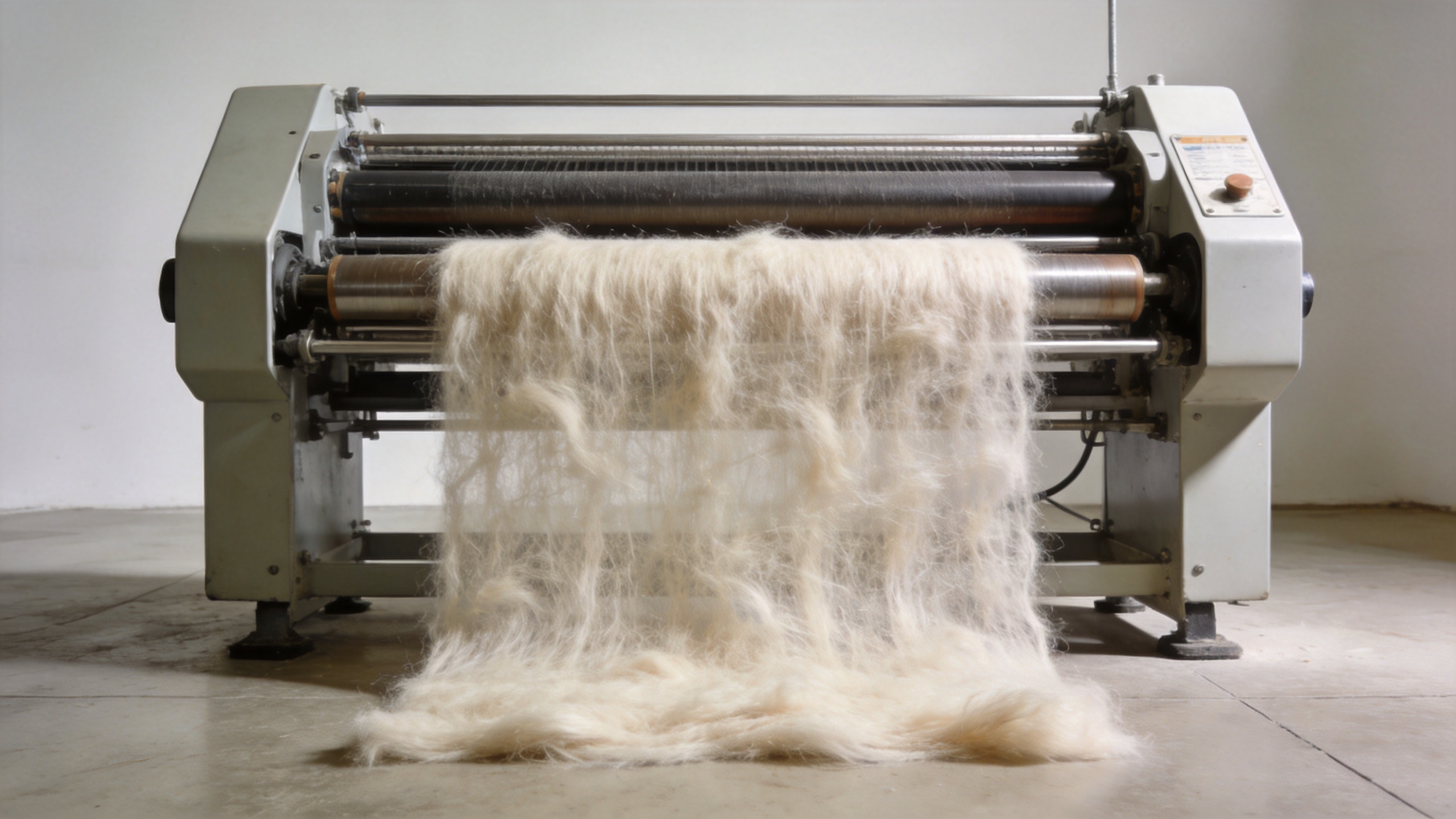
Spunlaid and meltblown processes form webs directly from polymer. Spunlaid production attenuates filaments and lays them into a web, while meltblown processing uses hot air to attenuate lower-viscosity polymer into much finer filaments. Those routes can be combined in layered structures, but their material behavior and operating windows should be reviewed separately. A fibre making machine discussion for direct-spun nonwovens needs polymer handling, extrusion, spinning, air systems, quenching or thermal conditions, web collection, bonding, and measurement to be visible in the scope.
Match fiber materials to the web-forming route
The selected fiber materials should be reviewed as a process input, not a label on a purchase order. For staple-fibre applications, teams may need to compare cut length, crimp, fineness, finish, blend compatibility, storage conditions, and variability in incoming material. For polymer-to-web routes, resin grade, viscosity behavior, additives, drying needs, and thermal history can influence the process questions. A fibre making machine cannot be evaluated responsibly without a defined input-material boundary.
This is especially important when recycled feedstock is under consideration. Recycled-content planning can be valuable, but it requires a documented discussion of feedstock condition, traceability expectations, contamination control, and verification. Rather than making environmental or output claims too early, set trial objectives and define which measurements will decide whether the material and process combination is acceptable.
Choose machinery by interfaces and verification points
When comparing a fibre making machine, map the equipment around the material flow. A useful review normally covers:
- Input and preparation: material receipt, storage, drying or opening, blending, conveying, and reject handling.
- Formation: staple-fibre preparation and card feed, or polymer melting, spinning, attenuation, and web collection.
- Bonding and conversion: mechanical, thermal, chemical, or hydroentanglement interfaces appropriate to the product concept.
- Quality checks: sampling points, records, laboratory methods, and agreed acceptance criteria.
- Plant interfaces: utilities, ventilation, layout access, safety review, automation signals, and handover responsibilities.
This approach is more informative than comparing headline capacity alone. A fibre making machine proposal may describe a core unit well while leaving critical interfaces unclear. Ask which items are included, which are supplied by others, what assumptions govern utilities and site layout, and what records will be available during commissioning. Those questions help procurement compare scope while helping engineers expose dependencies early.
Controls and data should serve operating decisions
Industrial manufacturing teams often request automation without first defining the decisions that data should support. For a fibre making machine, the useful conversation is about visibility: which conditions need to be observed, where alarms belong, what batch or run information should be retained, and how operators will connect process observations to web or finished-material checks.
Soft Gem describes its work as encompassing project planning, process-package and engineering-design discussions, equipment manufacturing, digital integration, product-performance assurance, and lifecycle services. For a nonwoven project, that stated scope can be a basis for asking structured questions about material flow and subsystem interfaces. The appropriate configuration, documentation, and verification requirements still need project-specific confirmation.
A practical selection sequence for textile applications
- Define the nonwoven end use and the properties that need evaluation.
- Specify the allowable fiber materials and the evidence required for incoming-material control.
- Choose the web-forming route: staple-fibre carded or airlaid, direct spunlaid, meltblown, or a layered concept.
- Map the fibre making machine to upstream preparation, downstream bonding, conversion, and quality interfaces.
- Request a scope matrix covering equipment boundaries, controls, utilities, documentation, commissioning inputs, and exclusions.
- Plan trials or qualification runs with defined samples, records, and decision criteria.
This sequence keeps textile applications connected to the actual process rather than to generic machinery terminology. It also makes it easier to compare proposals that use different names for similar functions.
Questions to take into an engineering review
Before advancing a fibre making machine concept, ask: What evidence links the proposed material route to the end use? Which fibre or polymer variables are within scope? Where does the web-forming responsibility start and stop? How will bonding and conversion requirements affect the upstream design? What tests will be used to review finished material? And which site, utility, safety, and operating assumptions remain open?
Clear answers do not remove every project uncertainty, but they create a disciplined basis for nonwoven production planning. By linking the fibre making machine to materials, web formation, bonding, controls, and verification, a team can move from a broad equipment inquiry to a more usable technical brief.



 Hot News