EN
How Recycled Fiber Production Supports Sustainable Textile Manufacturing
For textile manufacturers, recycled fiber is not simply a material claim. It is the output of a chain of decisions about collection, sorting, preparation, conversion, quality control, and end use. From a fiber-process advisory perspective, the useful starting point is the production objective: what properties must the finished yarn, nonwoven, filling, or fabric retain, and what variability can the plant manage?
That distinction matters because a recycled fiber program can support more responsible textile manufacturing only when material recovery and production controls work together. The goal is not to treat any recovered input as interchangeable with virgin raw material. It is to build a repeatable route from known feedstock to a fiber specification that downstream partners can evaluate.
Why recycled fiber changes the manufacturing conversation
Conventional textile production often begins with a defined raw-material specification. A recycled fiber route starts earlier, with the condition and composition of post-consumer or post-industrial feedstock. Color, polymer type, contaminants, moisture, finish residues, and the presence of blended fibers may all affect what happens later. Treating feedstock as a design input rather than a background assumption makes the process easier to manage.
This is especially relevant for recycled polyester fiber. PET bottles, production scrap, and textile waste can enter different recovery routes, but they do not present the same preparation requirements. Reliable identification and sorting help keep incompatible materials out of later thermal or mechanical stages. The practical question is not whether recovery sounds sustainable; it is whether the input stream and the target product are compatible.
The textile recycling process: where value is retained or lost
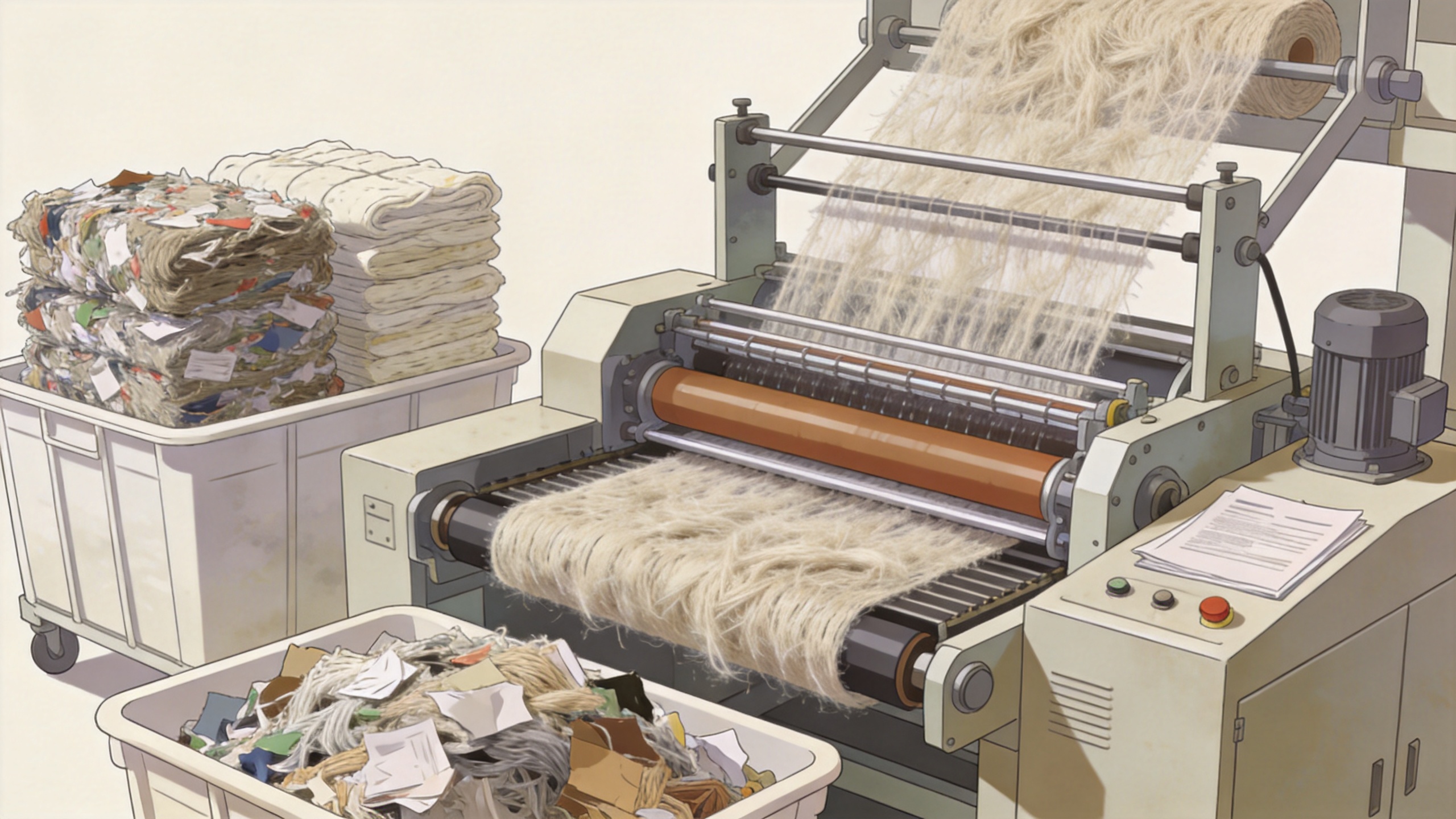
A typical textile recycling process can include collection, sorting, removal of non-textile components, cutting or shredding, opening, carding, and conversion into yarn, nonwovens, or another textile input. Each stage helps determine whether the resulting recycled fiber is appropriate for the intended application.
Sorting establishes the usable material stream
Sorting is often the first meaningful quality gate. It separates materials by composition, color, condition, and sometimes prior use. When blends, trims, coatings, or unwanted polymers remain in the stream, later processing can become less predictable. Plants should therefore define what the incoming recycled fiber feedstock may contain, how it will be checked, and when it should be redirected to another route.
Opening and preparation protect downstream consistency
Mechanical routes commonly reduce waste to smaller pieces and open it into recoverable fibers. This mature approach can be suitable for many applications, but repeated mechanical action may shorten fibers or change their quality. The appropriate response is not to make a blanket claim about performance. It is to match the recovered recycled fiber length, cleanliness, and blend ratio to the required yarn or nonwoven function.
Conversion requires an application-specific decision
Some streams are mechanically reprocessed; others may use chemical recovery to create purified feedstock for new polymer conversion. Chemical routes may offer a path toward high-purity material, while adding process complexity, energy demand, and chemical-management questions. A sustainable choice depends on feedstock, local infrastructure, energy sources, and the desired recycled fiber specification—not on a universal ranking of technologies.
How recycled fiber supports sustainability goals
The sustainability contribution of recycled fiber comes from keeping usable material in circulation and reducing reliance on new fossil-based inputs where the chosen route is suitable. Yet a responsible assessment looks beyond recycled content. Collection distance, sorting accuracy, electricity and heat sources, transport, water handling, and yield all influence the overall result.
That is why an eco friendly fiber claim should be supported by process evidence rather than a label alone. A plant may track incoming material composition, rejection rates, energy inputs, output yield, and the intended next use of its recovered material. These records make sustainability discussions more specific for customers, auditors, and internal teams.
For recycled polyester fiber, feedstock collection and sorting can be important life-cycle considerations alongside production energy. Locating recovery and conversion steps sensibly, improving material separation, and reducing avoidable losses can matter as much as the presence of recycled content. In other words, recycled fiber supports sustainability through disciplined system design.
Manufacturing controls that make recycled fiber more usable
A capacity target alone does not show whether a line is ready to produce consistent recycled fiber. Material handling, filtration or cleaning where applicable, thermal stability, controls, utilities, and quality-lab practices need review as connected interfaces. A fiber line should be planned around the tolerances of the chosen feedstock and the quality needs of the market it will serve.
- Define the target application: specify whether the recycled fiber is intended for spinning, nonwovens, filling, automotive textiles, home textiles, or another route.
- Set incoming-material criteria: document allowable polymer types, contamination thresholds, moisture conditions, and color expectations.
- Plan sampling points: check material before preparation, after conversion, and before shipment to identify variation early.
- Validate blends: determine when recycled and virgin inputs, or different recovered streams, can be combined for the required performance.
- Review interfaces: align process equipment, controls, utilities, and operator procedures with the actual material stream.
These practices help turn recycled fiber from an isolated purchasing requirement into a controlled manufacturing input. They also provide a practical basis for sustainable fiber technology: technology should make material flows visible and manageable, not merely add complexity.
A practical planning path for textile producers
Manufacturers considering recycled fiber can begin with a short feasibility sequence. First, define end-use requirements and the acceptable range of fiber properties. Next, characterize candidate feedstock and map the sorting and preparation needed. Then compare mechanical and chemical options against the same criteria: material compatibility, quality objectives, operating inputs, waste handling, and verification needs. Finally, validate the proposed route with trials and documented samples before treating it as a stable production specification.
For projects involving polyester staple fiber production, a whole-project discussion can help teams map these material, process, and engineering interfaces. The scope should be confirmed for the individual project, rather than inferred from a general sustainability objective. This keeps recycled fiber planning grounded in evidence and in the realities of production.
Moving from recycled content to accountable manufacturing
Recycled fiber gives textile manufacturers a way to recover value from suitable waste streams and reduce dependence on newly produced inputs. Its contribution becomes more credible when the textile recycling process is designed around feedstock quality, application requirements, measurable controls, and transparent boundaries. By connecting recovery decisions to manufacturing discipline, producers can use recycled fiber as part of a more considered approach to sustainable textile manufacturing.


 Hot News