EN
ES Fiber Production Challenges and Solutions for Manufacturers
In nonwoven manufacturing, ES fiber usually refers to a bicomponent fiber designed for thermal bonding, not telecommunications fiber. That distinction matters because a search for the term can surface irrelevant results, while a production team needs a practical view of polymer handling, spinning, drawing, crimping, cutting, and end-use validation. From a production-operations perspective, the useful question is not whether one machine setting is more advanced. It is whether the entire ES fiber process is stable enough to deliver the target web behavior under the customer’s bonding conditions.
Many fiber production problems begin when the target application is described too broadly. A fiber intended to contribute loft, softness, or bonding behavior in a nonwoven must be evaluated with the web process and thermal-bonding window in mind. In common sheath-core concepts, a lower-melting sheath is intended to soften during bonding while the core helps the fiber retain its structure. The actual material combination, cross-section, and operating window still require application-specific engineering confirmation.
Why ES Fiber Production Is a System Question
ES fiber manufacture links two polymer streams and several process handoffs that cannot be tuned independently. The feed system, melt condition, component ratio, spinneret distribution, quench air, take-up, drawing, finish application, crimping, and cutting all influence the fiber that reaches the customer. At first this can look like a spinneret or extruder issue; more precisely, it is a process-handoff issue. A stated throughput target does not by itself show whether utilities, material handling, controls, and downstream equipment are ready to support it.
Published bicomponent-fiber examples commonly describe melt spinning followed by quenching or solidification and drawing. For an ES fiber line, this sequence gives manufacturers a logical place to divide troubleshooting: first confirm material readiness, then verify component delivery, then check filament formation and cooling, and finally validate orientation and finish downstream. This order helps a team avoid changing several causes at once.
Challenge 1: Variable Raw Materials and Melt Consistency
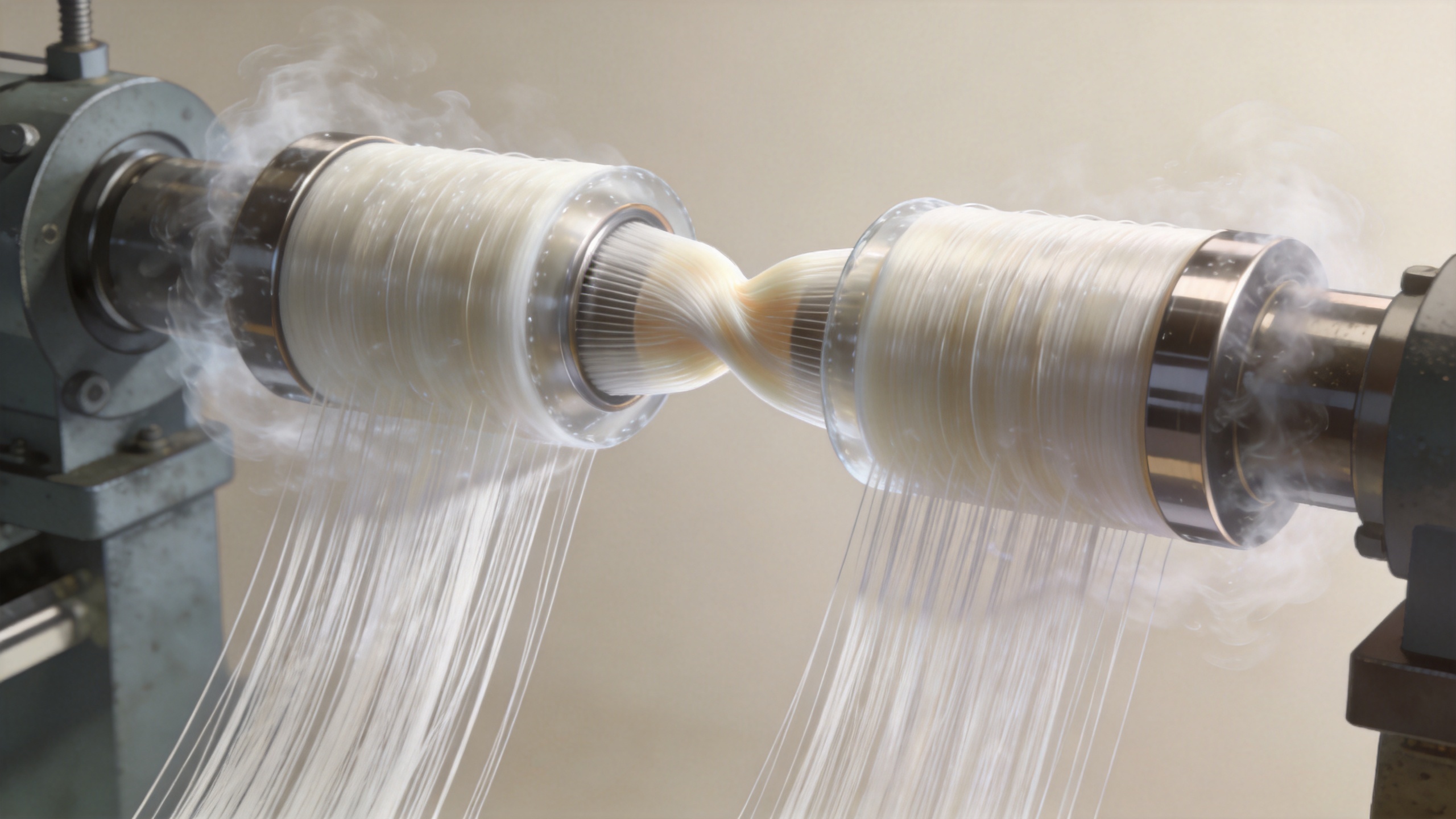
A change in resin lot, moisture exposure, contamination, additive package, or storage practice can show up later as unstable pressure, inconsistent filament appearance, or an uneven response in bonding. With ES fiber, the two components may not react to a disturbance in the same way. Treat each polymer as a design input rather than a background assumption.
Practical response
- Set incoming-material checks around the properties that matter to the chosen polymer pair and application.
- Record drying, conveying, melt-pressure, and temperature conditions by component rather than as one blended process record.
- Use a controlled trial plan when changing a resin grade, additive, or supplier, then compare fiber and web results before extending the change.
- Link lot records to finished-fiber samples so recurring fiber production problems can be traced rather than debated.
This is where manufacturing optimization becomes more than a speed increase. A stable material baseline gives operators a credible reference for identifying genuine process drift.
Challenge 2: Keeping the Sheath-Core Geometry Stable
The value of ES fiber depends on more than two polymers entering the same line. The intended geometry must remain sufficiently consistent through distribution and spinning for the downstream thermal response to be evaluated. Pressure imbalance, temperature variation, contamination, wear, or poor distribution can disturb that geometry. The result may be uneven bonding behavior, changes in hand feel, or unexplained variability in a converted web.
Practical response
Build a process map that pairs each observed defect with likely upstream checks. For example, a broad variation across positions should lead the team to compare component pressure, melt-temperature zones, distribution paths, filtration condition, and quench uniformity before changing draw settings. Instead of listing an equipment improvement as a generic upgrade, ask which observable operating question it will answer: component-flow balance, position-to-position variation, or response time after a disturbance.
| Observed condition | Review first | Evidence to retain |
|---|---|---|
| Position-to-position fiber variation | Component delivery and distribution consistency | Pressure, temperature, and sample records by position |
| Unstable filament formation | Material condition, filtration, spinneret cleanliness, quench | Lot history, screen-change log, defect images |
| Uneven bonding response | Fiber geometry, finish, web formation, bonding window | Fiber samples paired with web test conditions |
Challenge 3: Quenching and Drawing Are Often Treated Too Separately
For ES fiber, cooling and drawing influence the starting condition of the filament and the orientation developed downstream. A local quench imbalance can create variation that operators later try to correct with draw adjustments. That said, the next question is not which setting sounds more precise, but whether the line has enough measurement and operating discipline to distinguish cooling effects from draw effects.
A useful production technology plan therefore combines airflow review, temperature mapping, take-up stability, draw-ratio control, and sample comparison. Changes should be documented as bounded trials: state the objective, change one defined variable group, collect fiber samples, and compare the downstream response under the same web and bonding conditions. This approach supports learning without turning a short production run into an uncontrolled experiment.
Challenge 4: Connecting Fiber Measurements to Customer Use
Manufacturers can collect many line measurements yet still struggle to explain a complaint if the checks are not connected to end use. An ES fiber customer may care about bonding uniformity, bulk, softness, recovery, or processing behavior in a particular nonwoven route. A line team should translate each requested property into a verification path that includes fiber sampling, web formation, and the relevant bonding test conditions.
Do not use a single internal result as a universal performance claim. The appropriate bonding temperature, dwell, pressure, airflow, and web composition depend on the fiber design and the converter’s process. Before issuing a conclusion, identify what test method, sample conditioning, and acceptance criteria would support it. This evidence-first habit makes technical conversations clearer for production, quality, procurement, and engineering teams.
A Four-Layer Optimization Routine
- Define the target: document end use, target fiber characteristics, web route, and the customer’s most important evaluation criteria.
- Stabilize inputs: confirm material identity, handling conditions, component records, and maintenance status before adjusting operating windows.
- Observe the process handoffs: review component delivery, spinning, quenching, drawing, crimping, and cutting as connected stages of ES fiber production.
- Validate the result: retain representative samples and compare fiber data with web and bonding observations under documented conditions.
This routine helps teams prioritize equipment improvement where it improves visibility or control, rather than adding complexity without a defined decision purpose. For project discussions, a supplier that can help map process handoffs and clarify scope can support the questions that need site-specific confirmation; capability, output, delivery, and performance details should remain subject to the documented project scope.
Questions to Bring to an ES Fiber Line Review
- Which end-use requirement sets the limit for this ES fiber design?
- What evidence shows that both polymer streams are stable at the operating point?
- Where are quench and draw conditions measured, and how are position differences investigated?
- Which fiber production problems recur, and what records connect them to material, maintenance, or process events?
- What trial protocol will verify that a proposed manufacturing optimization improves the downstream result?
Conclusion
Reliable ES fiber production is built through controlled process handoffs, not isolated setpoints. When manufacturers begin with the end-use requirement, keep component data separate, investigate spinning-to-drawing dependencies, and validate fiber samples in the intended bonding route, they create a more useful basis for troubleshooting and improvement. The next step is to turn the current line’s recurring issues into a short, evidence-based review of inputs, process stages, and customer validation conditions.


 Hot News