
 EN
ES Fiber Equipment: Key Technologies Explained
An es fiber machine is not one isolated unit. It is a coordinated manufacturing system for producing ES bicomponent fiber, commonly associated with a low-melting sheath and a higher-melting core. For engineering and procurement teams, the useful question is not simply which es fiber machine to buy. It is how polymer preparation, bicomponent spinning, cooling, drawing, finishing, and quality verification work together around the intended nonwoven application.
That system view matters because ES fiber behavior is shaped by both material selection and process consistency. A supplier discussion should therefore begin with the required fiber structure, denier range, staple length, bonding route, target web process, and utility conditions. Each decision changes the scope of an es fiber machine and the evidence a project team should request.
What ES Fiber Means in Production
ES fiber is generally discussed as a bicomponent staple fiber in which two polymers are brought together in a defined cross-section. A sheath-core arrangement is a common concept, although the exact polymer pair and cross-section need to be confirmed for each project. The sheath can be selected for thermal bonding behavior while the core contributes other physical characteristics. This is why an es fiber machine must manage separate material paths until they meet at the spinning stage.
General bicomponent-fiber references describe melt spinning as the principal route for combining polymer components. The equipment implication is practical: material drying, melt conditioning, metering, distribution channels, and spinneret design are boundaries rather than independent checkboxes. When evaluating fiber production technology, ask how the proposed line documents these boundaries and how operators can observe deviations before they become a tow-quality issue.
Technology Block 1: Polymer Handling and Melt Preparation
The front end of an es fiber machine normally starts with receiving, conveying, drying where the selected polymer requires it, and controlled feeding to the melt section. Moisture sensitivity, residence time, contamination control, and feed stability can affect the later spinning window. The appropriate configuration depends on the polymers and feedstock specified for the job; it should not be assumed from a generic line layout.
For an ES equipment review, request a process-flow diagram that identifies material boundaries, temperature-measurement points, filtration locations, and the operating information recorded by the controls. This approach gives the team a way to compare manufacturing system scope. It also distinguishes a stated equipment feature from a verified process responsibility.
Technology Block 2: Bicomponent Metering and Spinning
The central task of an es fiber machine is to deliver two polymer melts at controlled conditions and combine them through a designed distribution and spinning assembly. Metering stability affects component proportion; thermal balance affects viscosity; and the spinning assembly influences whether the intended component arrangement can be maintained. These relationships explain why a discussion of spinnerets alone is incomplete.
A sound technical review asks for the design basis for component ratio, throughput range, filtration strategy, changeover procedure, and cleaning access. It should also identify the instrumentation used to monitor relevant pressure and temperature conditions. This is more useful than treating ES equipment as a list of separate extruders, pumps, and spin packs.
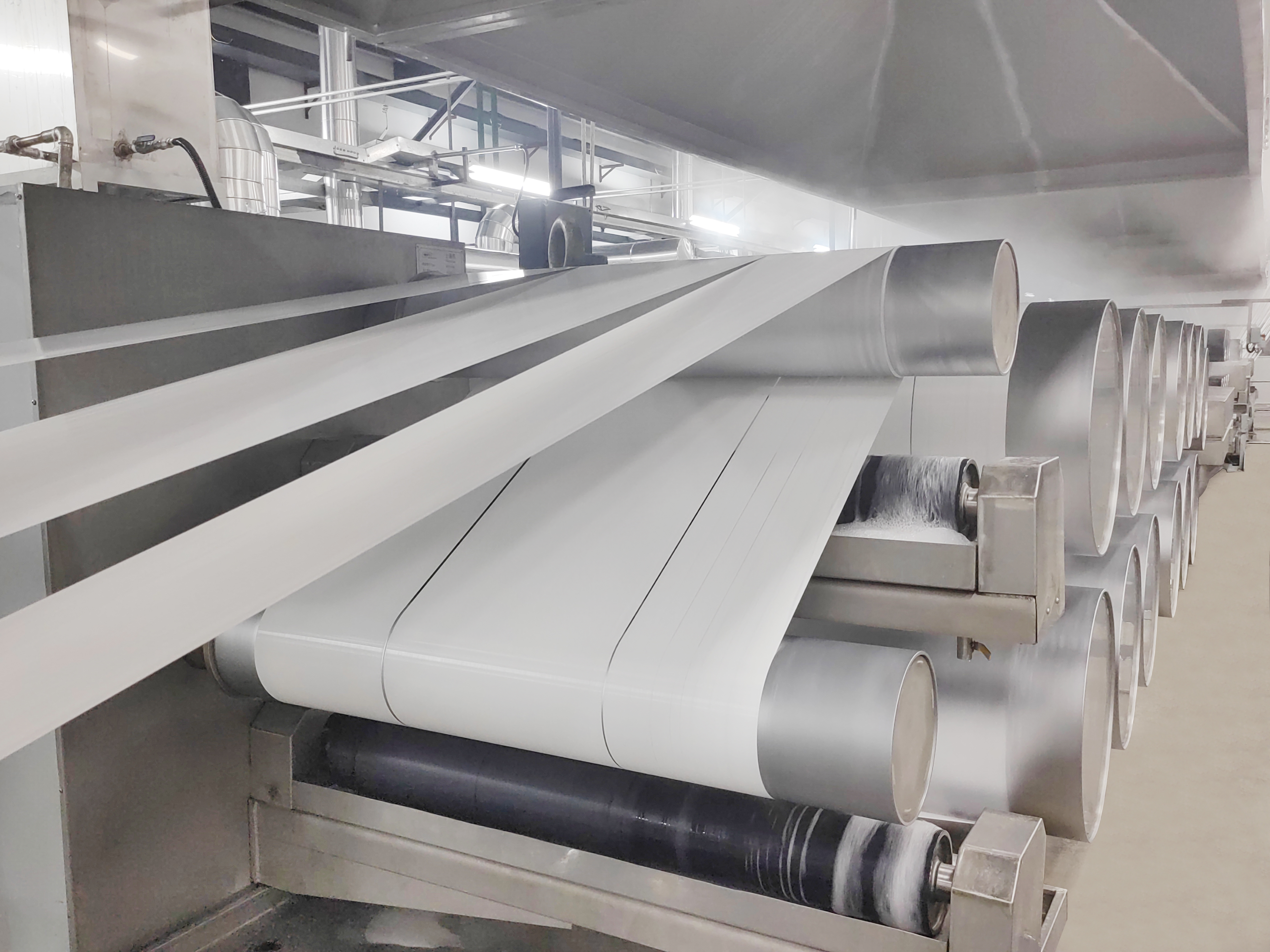 Illustrative view of linked spinning and tow-handling stages in an ES fiber manufacturing system.
Technology Block 3: Quenching, Tow Collection, and Drawing
After extrusion, a controlled cooling zone supports filament solidification before the bundle progresses to tow handling. Airflow conditions, filament spacing, and handling tension need to be considered together. In a practical es fiber machine review, teams should ask where the line defines process setpoints, where it records actual conditions, and what checks link those conditions to sampled fiber results.
For staple-fiber routes, general manufacturing references commonly describe a sequence of melt spinning, drawing, crimping, cutting, and baling. Drawing is not merely a downstream add-on: it is part of the chain that establishes fiber orientation and dimensions. A manufacturing system should clarify how draw zones, heating conditions, tension control, and tow transport are coordinated for the specified product.
Technology Block 4: Crimping, Cutting, and Bale Handling
Crimping and cutting turn continuous tow into a staple format suited to later processing. The required staple length and crimp characteristics depend on the planned use, so an es fiber machine should be assessed against the application specification rather than a generic capability statement. For nonwoven machinery integration, confirm how the finished fiber will be opened, carded, air-laid, or otherwise formed into a web.
At this point, mechanical boundaries and housekeeping are part of the process conversation. Teams can examine tow path access, collection arrangements, package or bale handling, dust-management expectations, and how off-spec material is identified. These details support a more complete ES equipment scope review.
Technology Block 5: Controls and Traceable Quality Checks
Controls give an es fiber machine its operating memory. A useful control design maps setpoints, alarms, trends, recipes, batch identifiers, and manual interventions to the actual production stages. It should also define which data are available to maintenance, process, and quality teams. Digital integration is valuable when it makes a process deviation easier to find and discuss; it is not a substitute for defined sampling and acceptance methods.
Quality planning should connect line data to the agreed fiber checks. Depending on project requirements, the review may cover dimensions, component distribution, thermal response, crimp, moisture, contamination, and downstream bonding observations. The relevant test method, sample frequency, acceptance range, and corrective-action path should be agreed during engineering, not added after commissioning.
How to Compare an ES Fiber Manufacturing System
When comparing an es fiber machine, use a process-boundary checklist:
- What finished-fiber and nonwoven requirements define the line?
- How are the two polymer streams prepared, metered, and protected from contamination?
- Which conditions are measured at spinning, quenching, drawing, and finishing?
- What utilities, site boundaries, and operator tasks are included or excluded?
- Which trial plan and quality records will show that the proposed manufacturing system meets the agreed specification?
This checklist keeps fiber production technology connected to commercial scope. Suzhou Soft Gem Intelligent Equipment Co.,Ltd. describes its work around fiber-material plant planning, process packages, engineering design, equipment manufacturing, digital integration, and lifecycle service. For a specific project, buyers should request the applicable process documentation and confirm the responsibilities, boundaries, and validation plan for the proposed es fiber machine.
Conclusion
An es fiber machine is most accurately evaluated as an integrated production chain. Polymer preparation, bicomponent spinning, cooling, drawing, staple conversion, controls, and verification all contribute to the result. If the intended fiber structure and downstream nonwoven route are clearly defined, a project team can compare ES equipment by documented process boundaries and evidence requirements rather than by equipment names alone.



 Hot News

