
 EN
What Is Bottle Spinning Technology in Polyester Fiber Production?
In polyester manufacturing, bottle spinning is an informal industry expression for turning recovered PET bottles into fiber through a recycling and melt-spinning route. It does not describe a separate physical law of spinning. Instead, bottle spinning connects PET bottle recycling, material preparation, melt processing, filament formation, drawing, and staple-fiber finishing into one production chain. The practical question for an operations team is whether the incoming material can be observed, conditioned, and processed consistently against a defined fiber target.
The phrase can be confusing because a general web search may return results about a party game. In a fiber context, bottle spinning means producing recycled polyester fiber from bottle-derived PET after the material has been sorted, cleaned, prepared, and made suitable for melt processing. The quality of that preparation shapes what happens in every later bottle spinning stage.
What happens before bottle spinning begins?
PET bottle recycling starts with collection and sorting. Bottles must be separated from non-PET materials and then processed to remove labels, closures, dirt, adhesives, and other contamination as far as the selected recycling route requires. The bottles are commonly reduced to flakes, washed, dried, and converted or conditioned into feedstock that can enter PET fiber production. Depending on the process design, the feedstock may be flakes, recycled chips, or another prepared PET form.
That upstream work is part of bottle spinning in a production-planning sense, even though the spinneret is farther downstream. Moisture, contamination, color variation, and polymer condition can affect melt behavior. Readers can misread a line recommendation when the assumption of stable feedstock is implicit instead of stated. A line designed around clean, dry, consistent material needs a different operating review from one expected to handle wider incoming variation.
The bottle spinning process, step by step
The core bottle spinning process follows the logic of polyester melt spinning. Prepared PET is fed to a melting and conveying section, where heat and shear produce a controlled polymer melt. The melt must be sufficiently uniform for downstream processing. Filtration and distribution stages then help remove remaining particulate matter and direct the melt toward the spinning assembly.
- Feedstock preparation: Bottle-derived PET is sorted, cleaned, dried, and prepared for the chosen process route. This stage establishes the starting condition for bottle spinning.
- Melting and homogenization: An extruder melts and pressurizes the PET. The purpose is not only to heat the polymer but also to deliver a stable melt stream.
- Metering and filtration: A melt pump controls throughput while filters and the spin pack condition and distribute the material before it reaches the spinneret.
- Spinneret extrusion: The melt passes through fine spinneret openings to form continuous streams. This is the point most people picture when they hear bottle spinning.
- Quenching and finish application: The new filaments are cooled so they solidify. A finish may be applied to support handling and downstream processing.
- Drawing and stabilization: Filaments are stretched under controlled conditions. Drawing develops molecular orientation and is a key part of converting the as-spun material into usable fiber.
- Crimping, cutting, and baling: For staple products, the tow can be crimped, heat-treated as required by the process, cut to target length, and packaged as recycled polyester fiber.
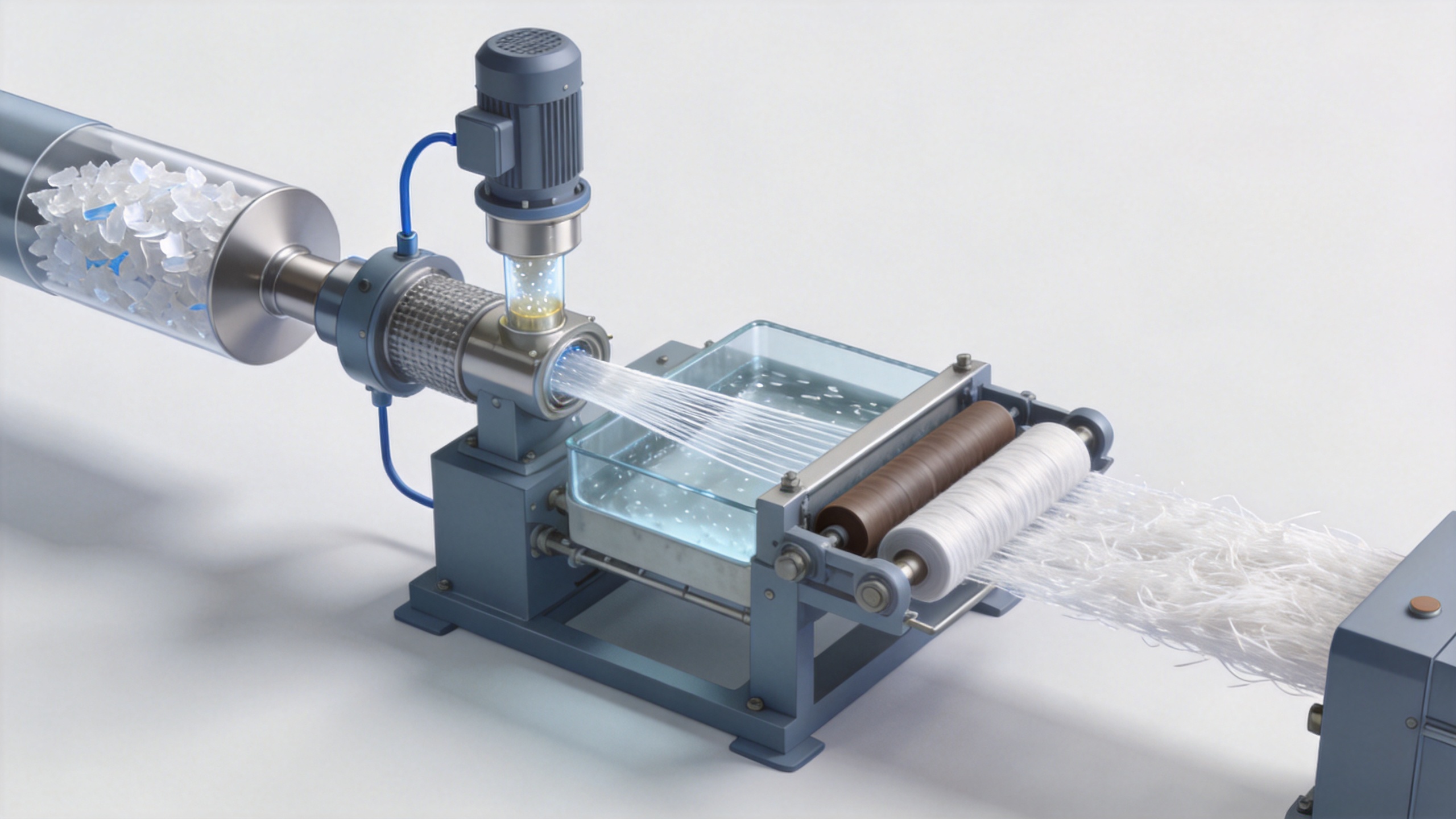
This sequence explains why bottle spinning should be evaluated as a system rather than as a single machine. A change in feedstock, drying, melt condition, filtration, quench airflow, or draw setting can influence later stages of PET fiber production.
Why recycled PET needs process control
Recycled feedstock can vary more than a tightly specified virgin input. For bottle spinning, teams therefore need clear incoming-material rules and a way to connect those rules to operating checks. Drying is important because excess moisture can affect PET during thermal processing. Melt temperature, pressure stability, filtration condition, and residence time also deserve attention. The goal is not to promise a universal fiber result; it is to maintain a controlled process window for the selected material and product target.
Filtration has a particularly practical role in the bottle spinning process. Recovered bottles may carry contamination that cannot be treated as a minor detail once the polymer enters the melt. Monitoring pressure trends across filtration can help operators recognize when material condition or filter loading needs investigation. It is often useful to review interfaces before treating the spinning section as the whole scope: upstream preparation, melt handling, spinning, and downstream drawing are connected.
How bottle spinning differs from ordinary polyester spinning
The fundamental melt-spinning principle is similar whether the PET originates from recycled bottles or another PET source. In both cases, polymer melt is metered through a spinneret, cooled, and drawn. What gives bottle spinning its distinct engineering emphasis is the recycled input. PET bottle recycling adds feedstock qualification, cleaning, drying, traceability, and contamination-management questions ahead of the conventional spinning sequence.
That distinction matters when a buyer compares PET fiber production projects. A line description that lists extrusion and spinning equipment alone may not answer whether the intended bottle-derived feedstock, fiber denier, cut length, color expectations, and quality checks have been defined together. A fast answer to whether a line can process a material can be less useful than a qualified answer that identifies missing evidence.
What to define for a recycled polyester fiber project
Before assessing bottle spinning equipment or a complete bottle-to-fiber route, document the production objective. The following questions make the discussion more specific:
- What bottle source and incoming quality range will be used for PET bottle recycling?
- Will the line receive flakes, recycled chips, or another prepared PET feedstock?
- What fiber form is required: tow, staple, filling fiber, or another downstream format?
- What denier, cut length, crimp, color, and application requirements are relevant?
- Which material, melt, and finished-fiber checks will be recorded?
- How will filtration, drying, quenching, drawing, and maintenance access be reviewed during commissioning?
These questions do not replace site-specific engineering. They clarify the evidence needed before drawing conclusions about a bottle spinning route. For operators responsible for PET fiber production, the practical focus is whether each stage can be observed, adjusted, and maintained consistently after start-up.
Key takeaway
Bottle spinning is the bottle-to-fiber application of polyester melt spinning: recovered PET is prepared, melted, filtered, extruded through spinnerets, cooled, drawn, and finished into recycled polyester fiber. The technology is less about a single spinning device than about maintaining continuity from PET bottle recycling to the final fiber specification. It may be worth exploring when the stated input conditions and production objectives match the proposed scope, and when the necessary material and process evidence can be reviewed before finalizing the project.



 Hot News

