EN
How Does a 4080 Low Melt Fiber Machine Work?
A 4080 low melt fiber machine is not simply a heater with a spinning unit. It is a coordinated fiber extrusion system designed to make staple fiber with a component that softens at a lower temperature than the rest of the fiber. That difference matters later, when the fiber is used in thermal bonding production for nonwovens, padding, insulation, filtration media, or other engineered textile structures.
For a project team, the useful question is not whether a 4080 low melt fiber machine is “advanced.” It is whether its material flow, temperature control, spinning arrangement, drawing path, and finishing sections match the fiber specification that must be confirmed. The sequence below explains the working logic without treating any target property as automatic.
What the machine is trying to produce
Low-melt fiber is commonly discussed as a bicomponent construction: one portion of the fiber is intended to retain more structure during later heating, while a lower-melting portion can soften and form bonds where fibers contact one another. A 4080 low melt fiber machine therefore has to do more than create filaments. It has to maintain a controlled relationship between materials from melting through fiber formation.
That relationship is why the low melt fiber process should be reviewed as a chain of connected stages. Resin condition, additive handling, melt delivery, spinneret geometry, quench air, drawing, crimping, and cutting can all influence how the fiber is handled downstream. The line should be specified around the intended fiber design and application, not around a model name alone.
1. Prepare and condition the polymer feed
The first working stage of a 4080 low melt fiber machine is feed preparation. Depending on the approved material design, polymer inputs are received, dried or conditioned as required, measured, and conveyed to the extrusion section. The purpose is to present a consistent feed to the melt system. Moisture, contamination, or uncontrolled variation can complicate later process control, so teams normally define incoming-material checks before discussing production settings.
At this point, fiber extrusion technology is a material-control task as much as a mechanical one. Each material stream needs an identified handling route, records for the selected formulation, and a clear process boundary. Exact resin grades, blend ratios, and drying conditions are project-specific inputs that should be established through technical validation rather than assumed from the equipment label.
2. Melt, meter, and combine the material streams
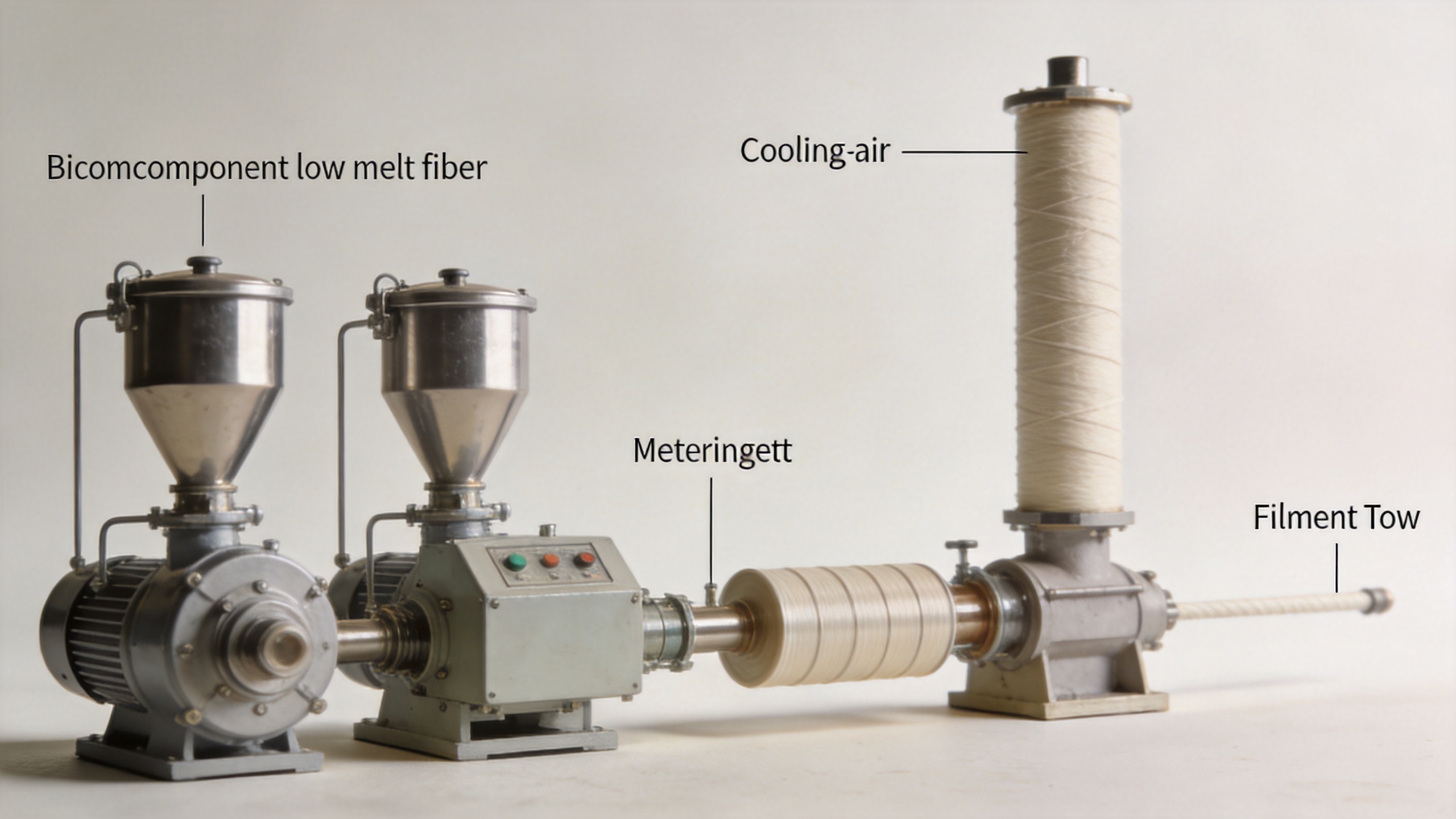
Inside a 4080 low melt fiber machine, extruders heat and convey polymer until it becomes a controlled melt. Filtration and metering sections then help deliver each stream at a stable rate. For a bicomponent fiber arrangement, the streams are brought together in a spinning pack or distribution system that creates the intended cross-section before the material exits the spinneret.
Common descriptions refer to sheath-core or side-by-side fiber designs, but the relevant configuration depends on the fiber’s end use and the approved material pair. The 4080 low melt fiber machine must keep pressure, temperature, and flow behavior within the project’s defined operating window. A mismatch at this stage may show up later as uneven component distribution, unstable spinning, or inconsistent response during thermal bonding production.
3. Form filaments through the spinneret
The spinneret is where the melt becomes many continuous filaments. In a 4080 low melt fiber machine, the spinning assembly turns the prepared bicomponent melt into an organized filament bundle. Spinneret design, pack cleanliness, melt condition, and distribution consistency are all linked. By process handoff, engineers mean precisely these transfer points between melt preparation, metering, and filament formation.
It is tempting to view this section as the whole machine. In practice, it is only one part of the low melt fiber process. A well-defined spinning stage still needs compatible cooling and take-up conditions to preserve a usable downstream fiber path.
4. Cool, gather, and draw the filaments
After extrusion, the new filaments are cooled with controlled air and gathered into a tow. The cooling step changes the physical state of the extrudate; it is not an afterthought. Uneven quench conditions can create differences across a tow, so air distribution and process observation belong in the line review.
The tow then passes through drawing and, where applicable, relaxation sections. Drawing helps orient the fiber structure and establishes a basis for the selected staple-fiber characteristics. A 4080 low melt fiber machine needs the draw path, roll speeds, tension management, and temperature zones to work together. The objective is not a universal draw setting; it is repeatable control for the selected material and fiber specification.
5. Crimp, set, and cut the fiber
Once the tow reaches the required process condition, a 4080 low melt fiber machine can feed it through crimping, thermal setting, and cutting sections. Crimp can support bulk and cohesion in staple fiber, while cutting converts the continuous tow into the selected staple format. The needed length, crimp profile, and finish must be linked to the end-use requirement rather than presented as fixed outcomes.
This is also where industrial fiber equipment becomes a system question. Conveying, collection, bale handling, controls, and quality sampling have to suit the material flow created by upstream spinning. A line plan that ignores these connected stages may create avoidable handling issues even if the extrusion section is operating as intended.
How the produced fiber supports thermal bonding production
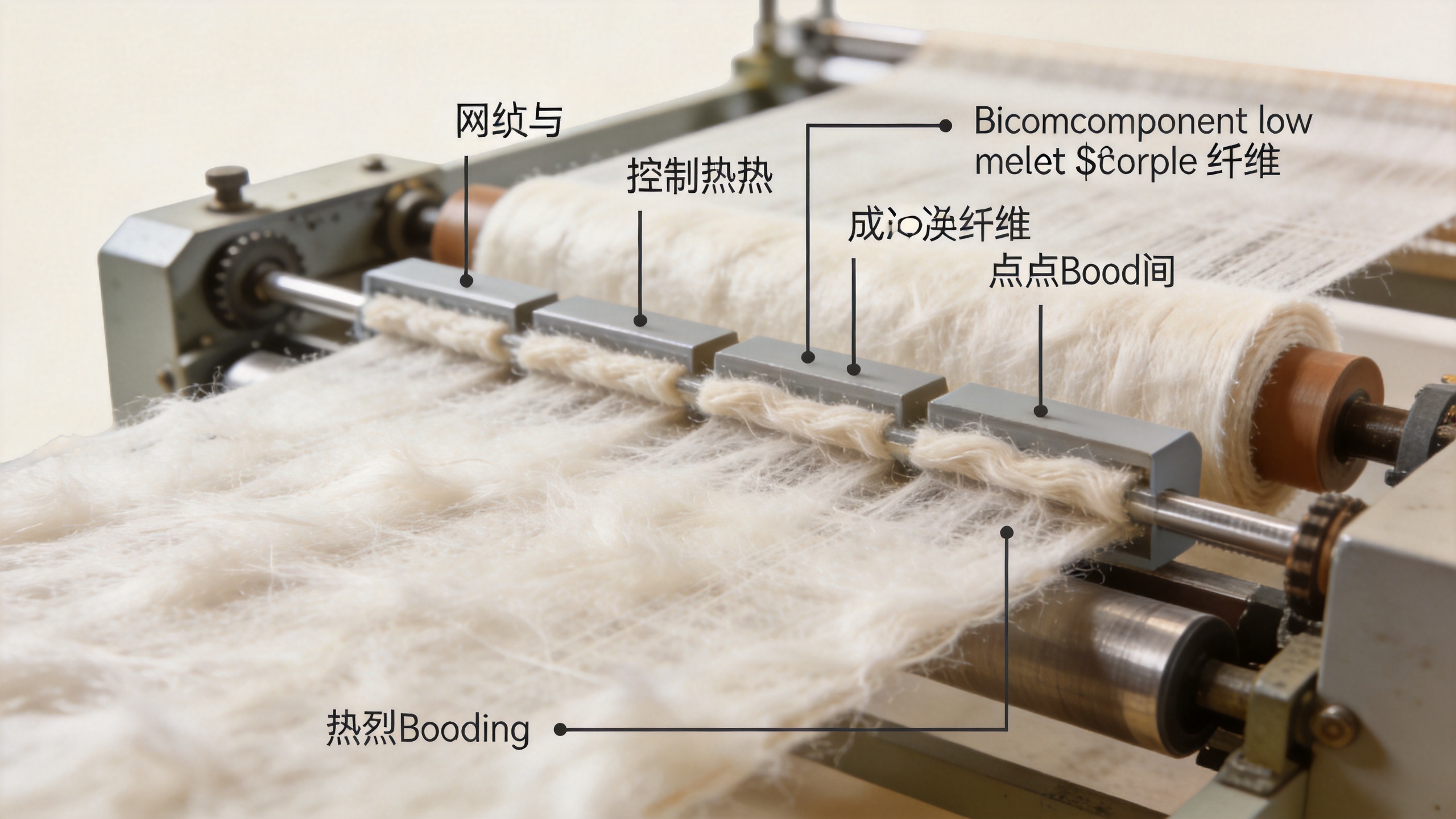
The 4080 low melt fiber machine makes the input fiber; it does not itself create every finished nonwoven product. In later thermal bonding production, heat is applied under conditions appropriate to the fiber system. The lower-melting component may soften at fiber contact points while the higher-melting component provides structural continuity. Cooling then helps stabilize the bonded web.
This downstream function explains why component distribution and fiber uniformity matter. It does not justify a blanket claim about bonding strength, temperature, or final product performance. Those outcomes depend on the fiber design, web composition, bonding equipment, residence time, pressure, cooling, and the validation method used for the target application.
What to confirm before specifying a 4080 low melt fiber machine
- Target fiber design: confirm the intended component arrangement, fineness range, staple format, and application requirements.
- Material evidence: request verified information for the selected polymers and any permitted additives rather than relying on generic terminology.
- Process handoffs: review material preparation, melt filtration, metering, quench air, drawing, crimping, cutting, and collection as one connected route.
- Quality plan: define what will be sampled, how component distribution and fiber characteristics will be assessed, and who approves deviations.
- Site conditions: identify utility, layout, controls, safety, installation, and handover requirements during engineering discussions.
A practical way to evaluate the line
A 4080 low melt fiber machine is most effectively evaluated through a specification-to-process map. Start with the finished product’s bonding and handling requirements, translate them into fiber requirements, then test whether the proposed fiber extrusion technology and downstream equipment scope address those requirements. This approach gives engineering, production, quality, and procurement teams a shared basis for questions.
For example, project discussions can separate what the 4080 low melt fiber machine is designed to control from what must be confirmed through material trials and finished-product testing. That distinction is useful when comparing equipment scope because it keeps process planning tied to evidence.
Conclusion
A 4080 low melt fiber machine works by preparing polymer inputs, controlling melt delivery, forming bicomponent filaments, cooling and drawing the tow, and finishing it as staple fiber for later use. Its value lies in the coordinated low melt fiber process, not in any isolated module. When the machine is matched to verified material, application, and site requirements, the resulting line discussion becomes more precise and more useful for thermal-bonding applications.


 Hot News