EN
How Biodegradable Fiber Is Manufactured Using Advanced Technology
A biodegradable fiber is not defined by a single machine or a single raw material. It is a fiber whose material, additives, structure, and intended end-of-life conditions must be considered together. From a fiber-process technical advisory perspective, the work starts with the target fiber specification and feedstock behavior, then traces the dependencies through spinning, drawing, finishing, and validation.
That distinction matters. A biodegradable fiber may be bio-derived, but bio based fiber production and biodegradation are not interchangeable claims. Likewise, a material described as biodegradable may require particular moisture, temperature, microorganisms, or time conditions before it breaks down. A responsible manufacturing process therefore begins by defining the fiber’s intended use and the conditions under which its end-of-life behavior will be evaluated.
1. Start with the polymer or natural feedstock
Manufacturers first select a feedstock that can meet the required processing route and end-use profile. Common routes may use biodegradable thermoplastic polymers, regenerated cellulose systems, or natural-fiber feedstocks. The choice is practical rather than cosmetic: the material must be available in a form that can be cleaned, prepared, and converted into a continuous or staple biodegradable fiber without unacceptable instability in the process.
For a thermoplastic route, incoming resin is typically checked for moisture and contamination before drying and metering. Moisture control is especially important when a polymer can degrade during heat exposure. For a cellulose-based route, the preparation may instead focus on solution quality, filtration, and coagulation compatibility. In either case, material consistency is a design input; it should not be treated as a last-minute quality-control issue.
2. Match the spinning route to material behavior
The core of fiber processing technology is choosing a spinning method that fits the material. Melt spinning is commonly used when a polymer can be heated and extruded through a spinneret without losing the properties needed for downstream drawing. The polymer is melted, filtered, metered, and formed into filaments as it exits the spinneret. Air cooling or controlled quenching helps solidify those filaments before further handling.
Not every biodegradable fiber belongs on a melt line. Published technical discussions note that thermal degradation, melt strength, and crystallization behavior can affect whether a polymer forms a stable spin line. A material with a narrow thermal window needs careful temperature, residence-time, and throughput control. Slow crystallization or low melt strength can also change the practical operating window. These are validation questions, not universal conclusions about any one resin.
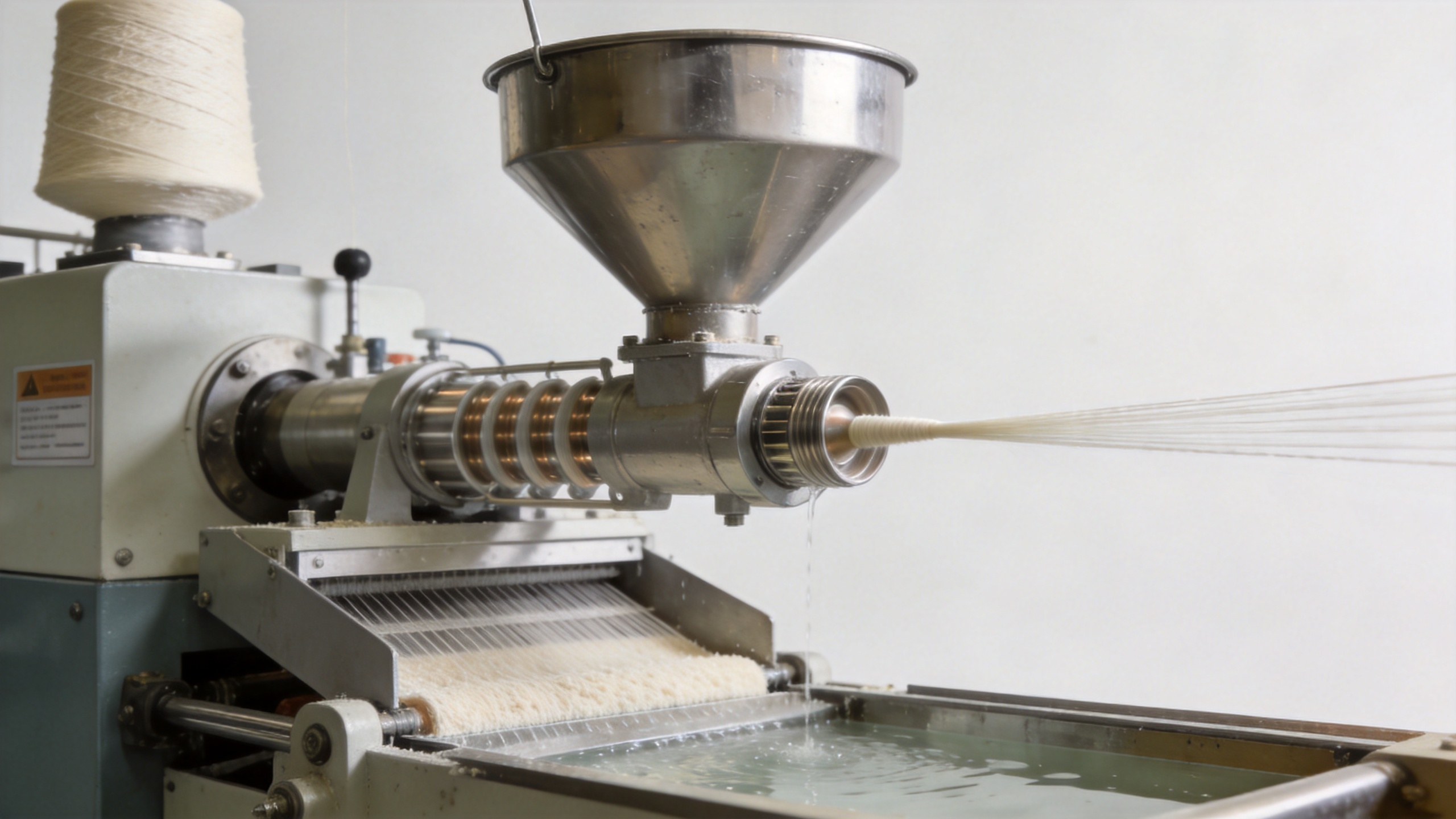
Wet spinning is another route for materials processed from solution, including certain cellulose-derived systems. Here, a prepared spinning solution passes through a spinneret into a coagulation bath, where the fiber-forming component regenerates or solidifies. The line then manages washing, solvent recovery where applicable, and drying. The route can be technically appropriate for a biodegradable fiber when the material cannot be processed as a stable melt, but its utilities and recovery requirements must be evaluated with the rest of the plant.
3. Form, cool, and stabilize the filaments
After extrusion or solution spinning, the young filaments have limited strength and are sensitive to disturbance. Quench conditions, air flow, bath composition, and godet settings influence how evenly the biodegradable fiber develops across the bundle. A stable line does not simply mean that filament is being produced; it means that variation is being controlled well enough for the intended downstream operation.
Filtration protects the spinneret from gels, agglomerates, or particles that may cause broken filaments and uneven denier. Metering and spin-pack condition help keep flow stable. Operators also watch for practical signals such as pressure movement, filament appearance, yarn tension, and breaks. These observations are useful because they connect the chemical behavior of the feedstock with the mechanical behavior of the line.
4. Draw and heat-set for the required structure
Drawing aligns polymer chains and changes the structure of the biodegradable fiber. The draw ratio, temperature profile, and relaxation conditions should be chosen against the product requirement, not copied from an unrelated fiber grade. In a manufacturing process for staple fiber, tow may be gathered, drawn, crimped when specified, heat-treated, cut, and packaged. Continuous-filament production uses a different downstream arrangement, but the same principle applies: each stage has to preserve consistent tension and controlled thermal history.
This is also where sustainable materials need careful language. A lower-impact objective does not remove the need to verify tensile behavior, elongation, shrinkage, moisture response, dyeability, or processing compatibility. The test plan should reflect the application, whether the fiber will become a nonwoven, yarn, filling material, or another construction.
5. Finish the fiber without losing traceability
Finishes, lubricants, antistatic agents, pigments, and blend components can affect both processing and final claims. For that reason, bio based fiber production benefits from batch-level traceability: record the feedstock grade, additive package, temperatures, lot transitions, and quality-test results. If a customer needs a biodegradability statement, the applicable test method, sample construction, and test conditions should be identified before the statement is made.
Packaging completes the physical production flow, but not the engineering work. Samples from each development or production run should be compared with the agreed specification. A small trial is valuable only when its processing conditions, observations, and results are documented well enough to guide the next scale decision.
Advanced technology is an integrated control problem
Advanced fiber processing technology is often described in terms of automation, sensors, or digital controls. Those tools can help, yet the more useful view is integrated control: feedstock preparation, dosing, thermal zones, spinning stability, tension, winding or cutting, and inspection must work as one system. A fiber-material project can therefore benefit from early process-package discussions that map utilities, controls, equipment interfaces, and commissioning questions around the target biodegradable fiber.
Before scaling, ask four direct questions: Can the feedstock remain consistent? Does the selected route fit its thermal or solution behavior? Which line signals will define a stable process? And which test conditions support the end-of-life claim? Clear answers turn a broad sustainable materials concept into a manufacturing process that can be reviewed, trialed, and improved.
Conclusion
Manufacturing a biodegradable fiber means connecting material selection with the right spinning route, controlled filament formation, drawing or stabilization, finishing, and application-specific verification. Melt spinning may suit some thermoplastic systems, while wet spinning may suit solution-based cellulose routes. The correct choice depends on the material and the specification. By treating feedstock behavior, process controls, and claim validation as linked decisions, teams can plan bio based fiber production with more useful technical evidence and fewer assumptions.


 Hot News