
 EN
How PET Fiber Production Lines Reduce Manufacturing Costs
A pet fiber machine affects cost long before the finished staple fiber reaches a bale. For plant managers, the useful question is not whether a line has a high nameplate output. It is whether the full process turns available feedstock into saleable fiber with stable energy use, predictable labor, and little rework. As a process-planning team for fiber-material plants, Soft Gem frames that question around coordinated stages: material preparation, melting, spinning, drawing, cutting, and quality feedback must work as one operating system.
A well-specified pet fiber machine can support cost reduction by controlling variation rather than by chasing a single maximum setting. Savings should be assessed against a plant’s actual feedstock, product specification, utilities, maintenance capacity, and shift pattern. The sections below show where a production line can influence the cost per kilogram of acceptable fiber.
Start with the cost drivers, not the purchase price
The capital cost of a pet fiber machine is only one part of a manufacturing decision. A practical cost model separates raw-material loss, electricity and thermal energy, labor, consumables, maintenance, downtime, and the cost of downgraded or rejected fiber. PET recycling research identifies electricity and natural gas as primary energy sources for running machinery and heating material, so both should be visible in the line’s operating review.
For each production run, record feed mass, accepted output, off-grade output, stops, kWh, thermal fuel where applicable, and operator interventions. This baseline makes it possible to locate the constraint. A pet fiber machine may be producing continuously while the plant still loses margin through unstable feed, excess drying time, frequent screen changes, or a finishing section that creates variation.
Reduce material loss before melt processing
Feedstock quality is often the first lever for cost reduction. Recycled PET can arrive with labels, moisture, mixed polymers, fines, or inconsistent flake geometry. When those variations reach a pet fiber machine, they can increase filtering load, disturb melt behavior, and create fiber that requires rework or cannot meet the intended grade.
Build the preparation stage around measurable acceptance criteria. Sorting, washing, size control, and drying should be treated as production controls, not isolated upstream chores. Reviews of PET recycling consistently identify collection and sorting as important to efficient recycling and waste reduction. In practice, this means setting receiving checks, segregating questionable lots, and using moisture and contamination records to decide whether a lot is ready for extrusion.
- Define incoming material limits for moisture, contamination, and particle consistency.
- Trend the relationship between lot quality and downstream filter changes or break events.
- Keep recoverable process scrap separate from unsuitable contamination so return streams remain traceable.
These steps improve production efficiency because operators spend less time reacting to preventable interruptions. They also make a pet fiber machine easier to tune: a stable input gives process settings a repeatable meaning.
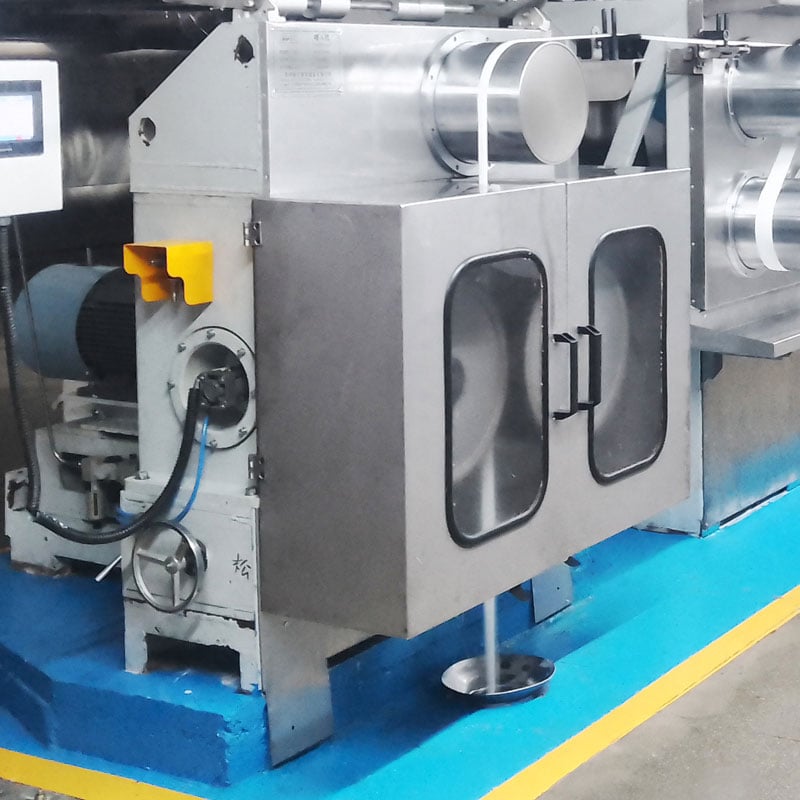 Process consistency begins with controlled material preparation and continues through fiber formation.
Match drying and extrusion capacity to the real bottleneck
Drying, conveying, melting, filtration, and extrusion need compatible throughputs. If a dryer is undersized, operators may compensate with rushed residence time or frequent pauses. If the melt section outruns downstream handling, the line creates inventory, tension changes, and avoidable starts and stops. A balanced pet fiber machine is therefore an equipment optimization exercise, not simply a selection of large individual modules.
During engineering review, map each module’s normal operating range, startup behavior, changeover requirement, and maintenance access. Then compare those ranges with the intended product mix. The goal is a controllable window rather than one point that works only under ideal conditions. Metering, temperature zones, pressure monitoring, and stable material conveyance help a pet fiber machine maintain conditions that support consistent spinning.
Instead of assuming that a faster setting means lower cost, test whether a speed increase changes denier stability, break frequency, filtration frequency, or accepted yield. A modestly lower setpoint can produce a lower unit cost if it reduces interruptions and off-grade fiber.
Use fiber quality as an operating signal
In fiber manufacturing, quality checks are part of cost control. Variation in denier, crimp, cut length, moisture, color, or contamination may not be visible in aggregate throughput figures, but it can affect customer acceptance and reprocessing time. A pet fiber machine should give operators timely process signals that can be compared with laboratory or in-line quality results.
Establish a simple feedback loop: define the critical quality characteristics, collect samples at agreed intervals, link each sample to line conditions, and investigate trend changes before a full lot is affected. For example, a rise in breaks may point to a feed, filtration, quench, draw, or tension issue. The value is not in blaming one station; it is in shortening the time between variation and corrective action.
| Cost signal | Useful operating question | Potential response |
|---|---|---|
| Off-grade fiber rises | Did feed quality or temperature stability change? | Review lot records and process trends before increasing throughput. |
| Stops become frequent | Which handoff point causes the stop? | Inspect material flow, filtration, drives, and planned-maintenance tasks. |
| Energy per accepted kg rises | Is the line spending longer at partial load or restarting often? | Balance scheduling, drying, and downstream availability. |
Plan maintenance around production evidence
Unplanned downtime can outweigh a small difference in the initial price of a pet fiber machine. Maintenance planning should focus on components that affect safety, material flow, thermal stability, pressure, tension, and fiber formation. Standardize inspections, retain records of recurring faults, and keep critical spare parts aligned with realistic lead times.
Condition-based maintenance does not require a complicated program on day one. Start with a failure log that records the component, symptom, production impact, corrective action, and repeat occurrence. When the same intervention appears repeatedly, the plant can evaluate whether a setting, procedure, operator handoff, or component choice needs revision. This supports cost reduction by reducing emergency work and improving schedule reliability.
Measure line economics by accepted output
A pet fiber machine reduces manufacturing cost when it makes the process more predictable: less feed variation reaches the melt, energy is reviewed per accepted kilogram, operators have actionable signals, and maintenance prevents recurring stops. The relevant metric is not gross output alone. It is accepted output at the intended quality divided into the full operating cost.
Before committing to a configuration, ask suppliers and internal teams to review the product range, feedstock condition, utility limits, expected operating hours, and service model together. Soft Gem’s stated plant-solution approach can help organize that scoping discussion, subject to project-specific technical confirmation. A disciplined review of the full pet fiber machine workflow gives manufacturers a clearer basis for improving production efficiency without relying on unsupported savings claims.


 Hot News

