EN
PSF Machine vs Traditional Fiber Production Equipment: A Comparison
Choosing a PSF machine is often described as a choice between modern equipment and a traditional fiber line. That framing is too simple. For an industrial buyer, the more useful comparison is between two production concepts: what each PSF machine scope includes, which interfaces remain outside the scope, and what evidence is needed before a project decision.
From a procurement perspective, an equipment list is only the starting point. A fiber line connects material preparation, thermal processing, spinning, drawing, crimping, cutting, handling, controls, utilities, and commissioning work. A PSF machine can be an integrated line concept or a narrowly defined core process package; traditional equipment can likewise range from a well-maintained dedicated system to separately sourced modules. The comparison should begin with the production objective, not a label.
First, define what is being compared
Before comparing a PSF machine with traditional fiber production equipment, put both proposals on the same boundary. In practical terms, a “machine” quotation may cover only selected process modules, while another proposal includes engineering interfaces, material transfer, electrical scope, instrumentation, or start-up support. Comparing prices before comparing boundaries can create a misleading fiber equipment comparison.
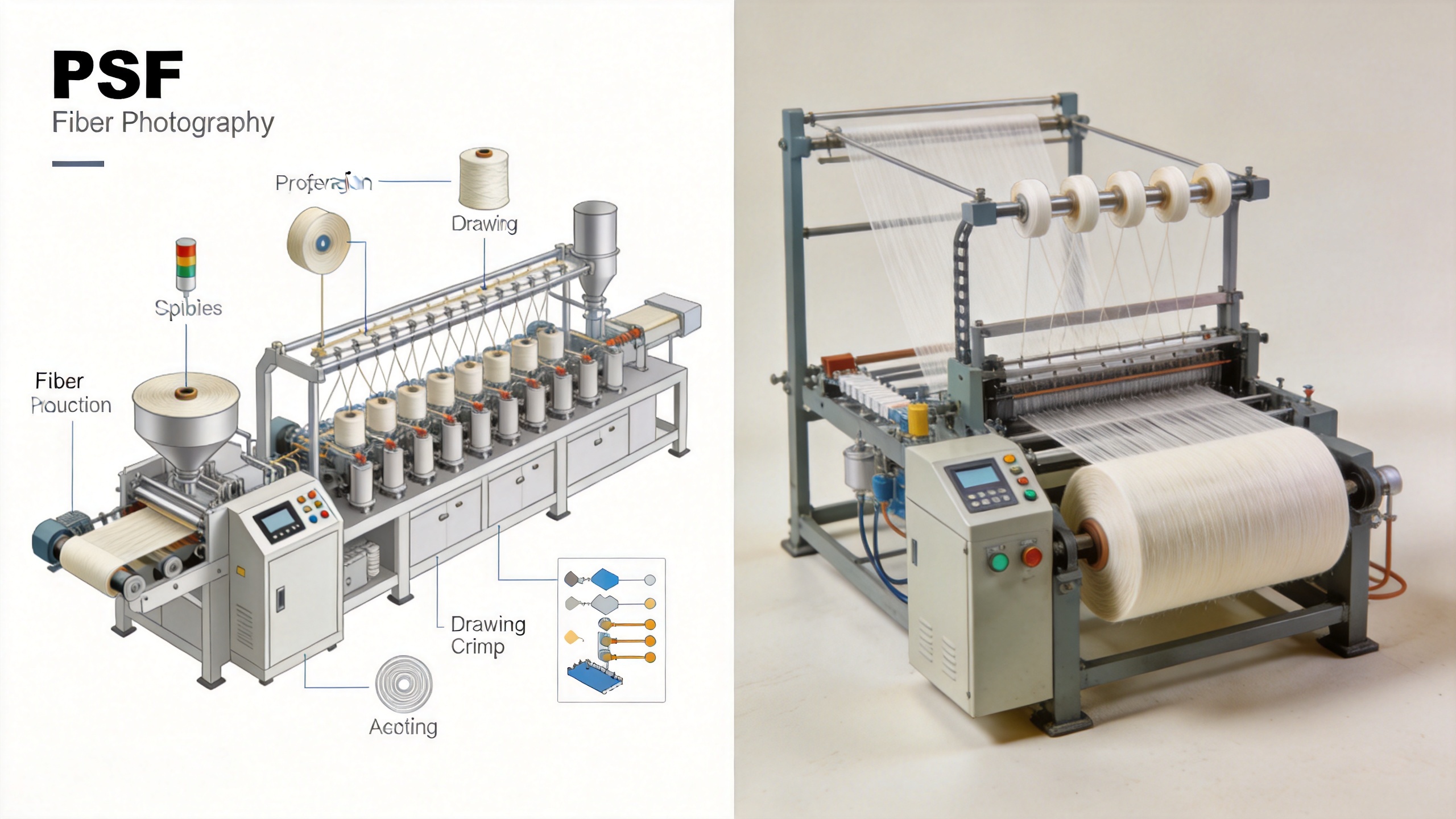
A useful system map follows the fiber from incoming polymer or prepared feedstock through melt handling, spinning, tow treatment, drawing, crimping, cutting, and finished-fiber handling. Not every project uses identical stages or configurations. Still, mapping upstream and downstream handoffs helps a team see which responsibilities sit with the PSF machine supplier, the site team, or other contractors.
How an integrated PSF machine is commonly evaluated
An integrated PSF machine concept is usually evaluated as a coordinated process path rather than a collection of isolated units. The potential value is not an automatic performance promise; it is the opportunity to review process dependencies together. For example, material condition, melt handling, spinning conditions, tow movement, thermal treatment, and downstream handling should be discussed as connected questions.
Controls are another part of the comparison. A PSF machine may be specified with a defined approach to operating visibility, alarms, records, and subsystem coordination. That does not mean one architecture is universally better. The relevant question is whether the controls scope fits the team’s operating workflow, maintenance capability, and information needs. If the site already has standards for automation or data handling, those requirements should be visible in the technical review.
For a buyer reviewing polyester machinery, the engineering package matters as much as the main process modules. Ask whether the proposal identifies interfaces for utilities, ventilation, material conveyance, electrical systems, safety review, and commissioning. A capability discussion around whole-project planning can help organize these questions, but each inclusion must be confirmed for the specific project.
Where traditional fiber production equipment can still fit
Traditional fiber production equipment is not one fixed category. It may refer to an established line, a legacy configuration, or equipment assembled from separately selected modules. This route can be appropriate when a plant has proven operating knowledge, compatible infrastructure, and a clearly bounded modification objective. In those cases, the goal may be to preserve familiar routines while addressing a defined bottleneck or replacement need.
The trade-off is coordination. When modules are sourced or managed separately, the team should document who owns performance discussions at each handoff. A traditional arrangement may also require closer review when product requirements, feedstock, operating practices, or data-visibility needs change. This is not a deficiency by itself; it is a reason to make dependencies explicit before expecting production efficiency improvements.
A practical comparison matrix
| Decision criterion | Questions for a PSF machine concept | Questions for traditional equipment |
|---|---|---|
| Process scope | Which stages and interfaces are included with the PSF machine? | Which existing modules remain, and who coordinates additions or replacements? |
| Product flexibility | Which target fiber ranges are proposed, and what must be verified by trials? | Can the existing configuration support the intended change without creating new constraints? |
| Controls and records | What visibility, alarm, and data functions are included in the PSF machine scope? | What integration or retrofit work is needed to achieve the desired operating visibility? |
| Utilities and layout | What site conditions must be confirmed before installation? | What existing connections, clearances, and maintenance-access limits affect the modification? |
| Validation | Which acceptance criteria, test methods, and commissioning records will be agreed? | Which baseline measurements are needed before and after changes? |
The matrix is deliberately neutral. It turns a feature list into decisions. At first this looks like a PSF machine question; more precisely, it is a process-and-interface question. The final assessment depends on the intended fiber specification, available site conditions, and evidence the team can review.
Compare fiber quality through evidence, not slogans
A responsible fiber equipment comparison does not treat target characteristics as automatically assured outcomes. Fiber properties depend on material, process conditions, equipment configuration, operating practice, and the applicable evaluation method. For manufactured staple fiber, crimp frequency is one example of a property that may be assessed with a recognized test method such as ASTM D3937 where applicable; a qualified team should confirm the relevant method, sampling plan, and acceptance criteria for the product and market.
For a PSF machine project, translate quality goals into review questions: Which fiber attributes matter? Which process variables may influence them? What samples, records, and inspection steps will support the decision? The same discipline applies to existing equipment. A modernization proposal should not be credited with a quality result until the evaluation approach and operating conditions are defined.
Use total project coordination as a selection criterion
The initial price of a PSF machine or a retrofit package is only one input. Review the scope required to install, connect, test, document, train for, and maintain the equipment. In a multi-supplier project, unclear responsibilities at subsystem handoffs can matter more than a small difference in the initial equipment list.
For teams considering Soft Gem as a discussion partner, the company’s stated whole-project planning and digital-information-integration focus can be used to structure questions about process scope and interfaces. It should not be interpreted as a promised project result. Request the specific process outline, included-equipment list, interface matrix, control description, and project-specific confirmation needed for the intended application.
Questions to take into an RFQ review
- What target fiber specification and feedstock conditions define the project?
- Exactly which process stages are included in the PSF machine or traditional-equipment proposal?
- Which utilities, controls, civil works, and material-handling interfaces need site confirmation?
- What operating, maintenance, and commissioning responsibilities belong to each party?
- What trial plan, test methods, records, and acceptance criteria will be used to evaluate the result?
These questions make manufacturing technology comparable on a practical basis. They also help engineering, production, quality, and procurement stakeholders work from the same assumptions.
Choose the concept that matches the verified objective
A PSF machine may be the stronger direction when the project needs a coordinated process scope, a defined control approach, or a new line concept that warrants integrated engineering review. Traditional fiber production equipment may be the sensible direction when existing assets, experienced personnel, and site interfaces already fit a tightly defined objective. Neither conclusion should be made from a generic feature list.
The next step is to convert the comparison into a project-specific scope and evidence checklist. When objectives, boundaries, and validation needs are visible, a PSF machine decision becomes easier to defend across the whole team.


 Hot News