EN
Key Technologies Behind Modern Polyester Staple Fiber Production
A modern polyester staple fiber production line is not simply a sequence of machines that melts PET and cuts tow. It is a coordinated system in which material condition, melt quality, filament formation, thermal treatment, mechanical handling, controls, and testing influence one another. From a plant-engineering planning perspective, the useful starting point is the target fiber specification and application—not an isolated equipment feature. It gives a project team a clearer way to ask whether each interface can support stable, verifiable production.
For spinning-grade, nonwoven, filling, hollow, or recycled-fiber applications, the process package must translate desired denier, cross-section, crimp behavior, finish response, and cut length into controllable conditions. The sections below explain the technologies that make a polyester staple fiber production line more observable and easier to evaluate. They are decision points to validate during engineering, not universal performance promises.
1. Polymer preparation: protect the process before spinning begins
Polyester production starts with a material-handling and preparation strategy. PET chips, flakes, or other approved feedstock need a defined route for conveying, drying, dosing, and melt preparation. Moisture, contamination, particle size variation, and inconsistent lot handling can all change the questions that the downstream process must answer. A stated capacity target, by itself, does not confirm that feeding, drying, filtration, utilities, and controls are ready to support it.
Modern preparation sections commonly use monitored drying conditions, gravimetric or controlled feeding, melt filtration, and pressure/temperature observation to make changes visible before they become a spinning issue. The exact configuration depends on feedstock and the fiber target. For a recycled-material program, treating feedstock as a design input rather than a background assumption is particularly important. The engineering review should identify what material data is available, where it is sampled, and how deviations are handled.
2. Melt spinning technology sets the starting geometry
In a polyester staple fiber production line, extrusion and spinning convert a conditioned melt into a large filament bundle. Extruder stability, filtration, metering, distribution, and spinneret condition work as a system. Spinneret geometry and polymer distribution influence the initial filament geometry, while pressure and thermal control help the team assess whether the process is operating within its intended window.
This is where advanced fiber technology becomes a practical engineering question rather than a label. A project may require a conventional solid fiber, a hollow profile, or a more specialized configuration. Instead of treating the spinneret as the entire answer, engineers should map the feature to the required polymer flow, cooling behavior, downstream drawing route, inspection plan, and cleaning or changeover needs. That mapping makes equipment selection more useful because each feature is tied to an operating question.
3. Quenching and tow handling turn filaments into a controllable bundle
Freshly extruded filaments must be cooled in a controlled manner before subsequent handling. Quench-air distribution, air condition, consistency across the spinning field, and the layout of guides and take-up components are important interfaces. Uneven cooling or unstable handling can complicate later evaluation of yarn or fiber uniformity, even when the upstream melt section appears normal.
In practice, a polyester staple fiber production line benefits from instrumentation that lets operators see relevant process conditions instead of relying only on end-of-shift observation. Trendable temperature, pressure, airflow, speed, and alarm data can support structured troubleshooting. The goal is not to assume that automation guarantees quality. It is to create a traceable connection between an observed change, a process condition, and the validation work that follows.
4. Drawing and heat treatment develop useful fiber behavior
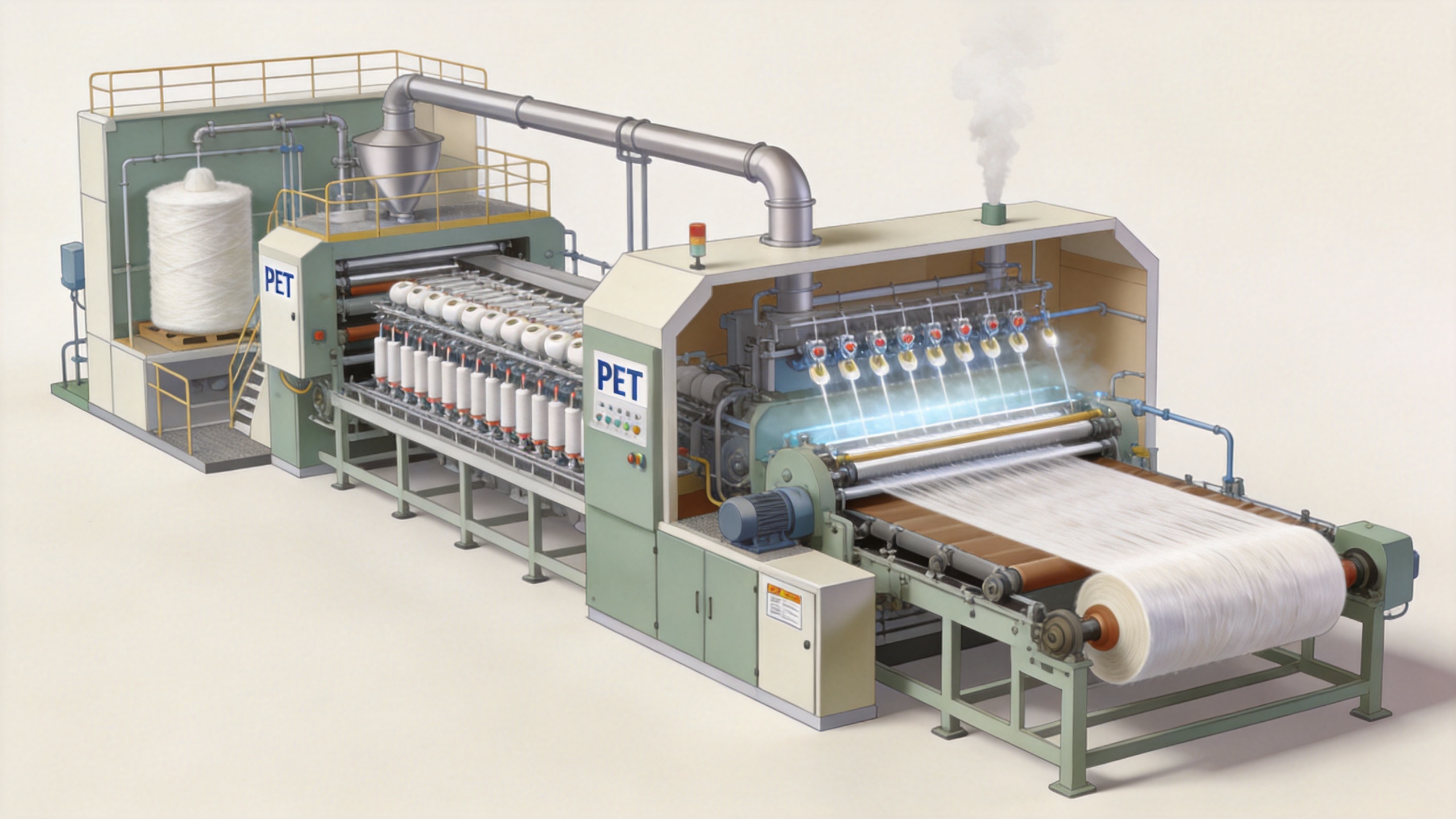
Drawing aligns the polymer structure and is one of the most consequential stages in the polyester production process. A tow path must maintain stable tension while heated rolls, draw ratios, temperatures, and residence times are coordinated with the incoming filament state. The next question is not which draw frame sounds more advanced, but which configuration fits the target fiber, planned throughput, utility conditions, and maintenance access.
Heat-setting or relaxation stages may be reviewed with drawing because their interaction affects the process route. A technical team should define which quality characteristics it will examine after those stages and which process records are needed to investigate a deviation. Where physical or mechanical textile tests are part of the quality plan, ISO 139:2005 is a relevant reference for the use of standard atmospheres for conditioning and testing textiles. It does not establish a product claim; it helps frame why repeatable test conditions matter when results are compared.
5. Crimping, finishing, and cutting must match the end use
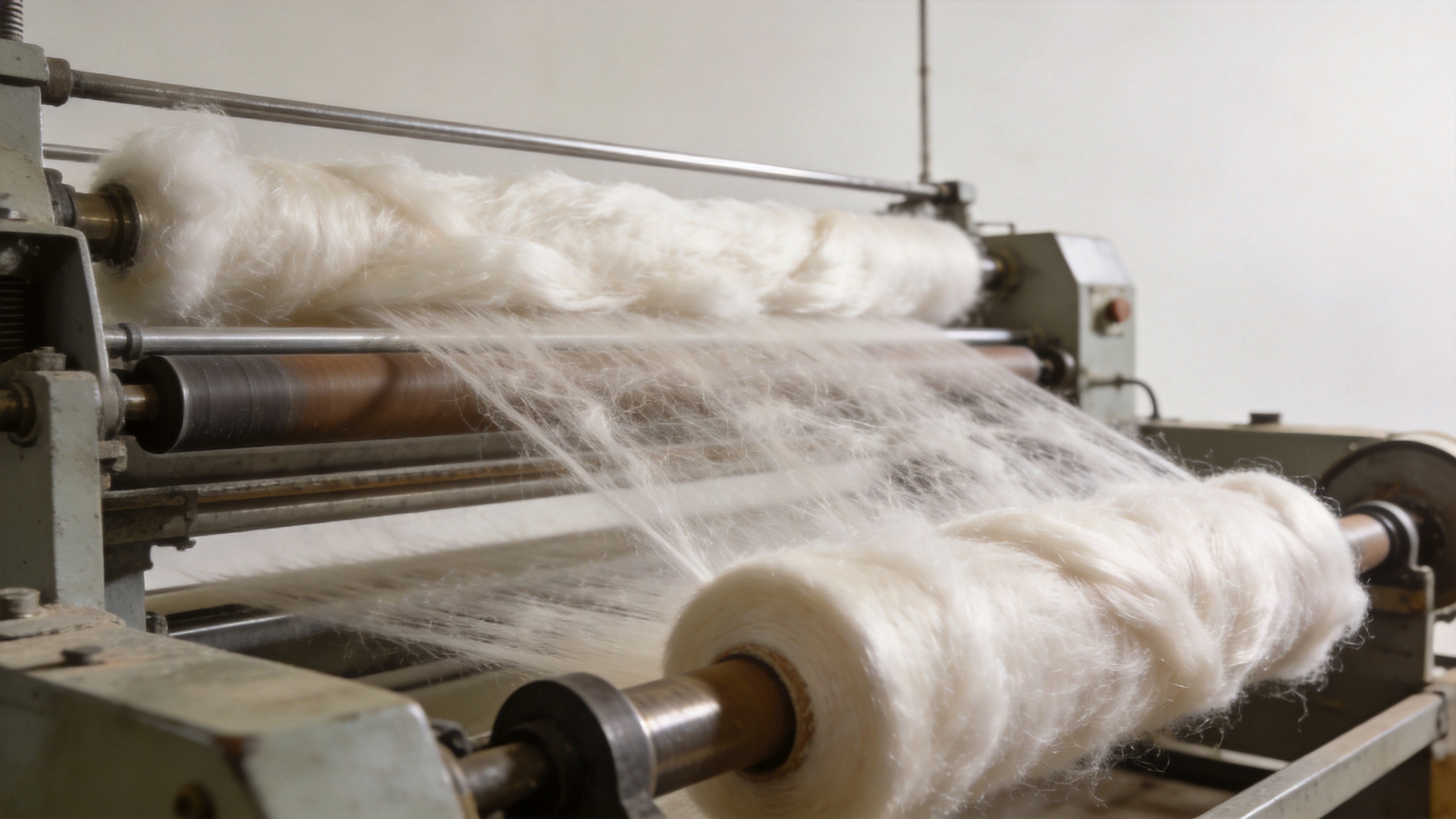
After drawing, a staple-fiber route often uses crimping, finishing, drying, and cutting to create a fiber that can be processed as intended. Mechanical crimping technology, finish application, drying conditions, and cut-length control should be considered together. A change in one may affect handling or downstream processing, so it is more accurate to review the interface than to present any component as a stand-alone solution.
For example, fiber intended for a textile route may require a different discussion from fiber planned for nonwovens or filling. A sensible review asks what properties must be confirmed, what samples are representative, and how the process team will trace samples back to operating conditions. This is also where fiber equipment innovation should be judged by the decision it supports: easier adjustment, clearer monitoring, safer access, cleaner handoff, or more reliable documentation.
6. Smart manufacturing connects decisions across the line
Smart manufacturing in this context means creating useful visibility across a process, not adding dashboards for their own sake. A well-scoped control architecture can collect operating signals, align setpoints and alarms with the production recipe, preserve batch or shift context, and make handoffs between process stages easier to investigate. The relevant scope should be confirmed early: which systems exchange data, who owns each signal, how data is retained, and what action follows an exception.
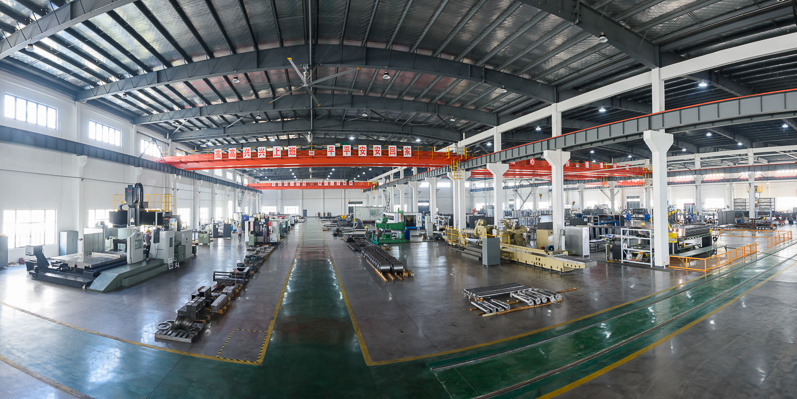
In engineering planning, it is useful to map material flow, thermal systems, utilities, controls, and commissioning interfaces before treating the core equipment as the whole scope. This protects the project from a common gap: a line may be specified in detail while access, ventilation, power, water, compressed air, material logistics, or data responsibilities remain unclear. Soft Gem’s stated process-package and engineering-design context can be a useful consultative discussion point for reviewing those interfaces, subject to project-specific confirmation.
A practical technology checklist for project teams
- Define the target fiber and the properties that will be checked before comparing modules in a polyester staple fiber production line.
- Document feedstock condition, sampling points, and the process response expected when inputs vary.
- Review melt, spinning, quenching, tow handling, drawing, crimping, finishing, and cutting as connected interfaces.
- Identify the signals operators need, the alarms that require action, and the records needed for later traceability.
- Confirm utility, layout, maintenance-access, safety, and commissioning responsibilities alongside the equipment scope.
- Agree on representative sampling and conditioned testing practices before drawing conclusions from quality data.
Conclusion: technology depends on well-engineered interfaces
A useful technology plan for a polyester staple fiber production line is usually a system plan. Material preparation protects spinning; spinning and quenching shape the starting tow; drawing, thermal treatment, crimping, finishing, and cutting build the intended fiber behavior; and controls make the process easier to observe and verify. Before selecting a configuration, connect each technology to a target requirement, a process dependency, and the evidence needed at commissioning. That produces a more useful engineering conversation than a feature list alone.


 Hot News